
Why the practical difference may be less about coherence and more about controlling dose.
In my experience, I’ve been to clinical and wellness practitioners such as chiropractors and physical therapy offices, in which I’ve experienced using a laser to treat ailments I’ve had. Examples are Therapy Lasers made by LightForce FXi, that I understand costs $35,000. Alternatively, the market is full of LED based systems. When researching pubmed for photobiomodulation, I come across studies from both types of technology. They use similar wavelengths, both use energy in the form of light, and both have thousands of studies examining their effects across a range of conditions. If one system costs tens of thousands of dollars and requires a trained practitioner, while another can be purchased for home use, one has to wonder if the consumer homebased system works at all? If it does, what is the advantage of the professional laser system?
What Photobiomodulation Research Actually Measures
To evaluate whether laser and LED sources produce equivalent effects, it helps to first understand how PBM research specifies treatment parameters, because the units matter.
Most published PBM studies do not describe treatment as “ten minutes under a light.” They specify irradiance, the optical power delivered per unit area, measured in milliwatts per square centimeter (mW/cm²), and total dose, the energy delivered per unit area over the course of a session, measured in joules per square centimeter (J/cm²).
The relationship is straightforward:
Dose (J/cm²) = Irradiance (mW/cm²) × Time (s) ÷ 1000
A device delivering 50 mW/cm² for 200 seconds delivers 10 J/cm² to the treatment site. A device delivering 100 mW/cm² for 100 seconds delivers the same dose in half the time. The biological question the research is asking is whether a given dose, at a given wavelength, produces a measurable effect in tissue.
This matters for the LED versus laser comparison because it reframes the question. The relevant variable is not which type of source was used. It is whether the intended dose was actually delivered to the target tissue, at the right wavelength, at a controlled irradiance, for the right duration.
That distinction will become important.
Lasers: Historical Advantages and Modern Questions
Lasers emit coherent light, photons that are in phase, traveling in a collimated beam. LEDs emit incoherent light, diverging from the source across a narrow spectral distribution. Coherence is frequently cited as the reason laser systems outperform LEDs. The proposed mechanism, as Heiskanen and Hamblin note in a 2018 perspective article in Photochemical & Photobiological Sciences, is that coherent light interacting with tissue microstructure creates interference patterns called “laser speckles” whose dimensions approximately match those of mitochondria, potentially conferring a stimulatory advantage that incoherent LED light cannot replicate. The evidence for this is less convincing than the price differential might suggest, and the assumption itself may be an artifact of history rather than data.
Photobiomodulation research began in the late 1960s using the newly invented laser as its primary tool, and the field became known as “low-level laser therapy” for the simple reason that lasers were the accessible, controllable light source of the era. As Heiskanen and Hamblin note, this laser-centered history became the basis for assuming that the therapeutic effects of red and near-infrared light were somehow dependent on laser-specific properties such as coherence, collimation, or polarization, an assumption they describe as “certainly debatable and probably not true.”
A related claim, that pulsed lasers penetrate deeper than continuous sources, is similarly complicated by measurement methodology. As Heiskanen and Hamblin observe, it is usually not mentioned that the actual energy reaching depth is only a fraction of peak power figures suggest, since pulsed light is only active a small fraction of the time. Kaub and Schmitz (2022, Biomedicines) described in the abstract that for “all investigated tissues, most initial light energy was lost within the first one to two millimeters, more than 90% was absorbed within the first ten millimeters, and there was hardly any energy remaining after 15–20mm of tissue.” The abstract finding requires some qualification, as the body of the work and conclusions stated “the laser beam characteristics are highly important for the penetration depth of laser light in tissue.” They further described depth was highly dependent on wavelength and beam characteristics which are not often well-reported. Delivered deep-tissue dose comparing lasers and LEDs remains quite complex and not yet resolved.
Comparing general use of lasers and LEDs for photobiomodulation applications, Pruitt et al. (2022, Metabolites) compared an 800nm laser and an 810nm LED in vivo using cytochrome c oxidase redox activity and hemoglobin oxygenation as outcome measures. Session duration was held constant across both sources, with dose a direct function of each source’s irradiance over that fixed time period. The laser operated at more than twice the irradiance of the LED (310 mW/cm² vs 135 mW/cm²) with comparable session durations, meaning the LED delivered a lower total dose. Despite this, both sources produced significant, measurable increases in both physiological metrics, with the LED’s smaller absolute response proportional to its lower delivered dose rather than indicative of any source-type disadvantage. The authors note that most commercial LED units operate at irradiances lower than research settings, and suggest that extending session duration would be a practical way to compensate, since dose is irradiance multiplied by time, a lower irradiance source can reach the same J/cm² target by running longer. What the data does support is a more limited but still meaningful point: an LED source operating at moderate irradiance can produce significant physiological responses even without matching the dose of a laser system, suggesting that source type is not the primary determinant of outcome. Whether that reflects a dose-dependent relationship or a threshold effect below which the response saturates remains an open question.
The Laser’s Real Advantage: Delivery Control
The laser’s most important practical advantage may not be coherence nor penetration depth at all. It may be the ability to maintain a predictable irradiance at the treatment site despite small changes in working distance. A collimated beam maintains its intensity over distance in a way that a diverging LED source does not. Move an LED device a few centimeters further from the treatment site and irradiance drops substantially, the energy spreads across a larger area, reducing the dose delivered per unit area. A collimated laser beam is considerably less sensitive to small distance variations. For a given output power, irradiance at the treatment site is more predictable.
In a clinical setting, this is a meaningful engineering advantage. The practitioner does not need to precisely control distance to maintain a consistent irradiance, the source geometry does that work. This may partially explain why early laser therapy research produced interpretable results: the delivery was geometrically stable in a way that consumer LED systems typically are not.
However, this advantage has a practical limit. A laser’s collimated beam covers a small area. Treating anything beyond a point target requires the practitioner to move the device, scanning across the treatment area to achieve adequate coverage. That introduces its own variability: dwell time, positional overlap and consistency across sessions. The laser controls irradiance magnitude well. It does not control where that irradiance is applied, or for how long, at each point across a treatment area.
This is where the clinical setting provides something the source type cannot: a trained practitioner managing application technique. The laser handles magnitude. The professional handles coverage. The two together constitute a controlled delivery system, but neither alone is sufficient.
The Case for Controlled LED Delivery
If the clinical laser system’s advantage is primarily one of delivery control, predictable irradiance magnitude, managed by a practitioner who handles coverage and technique, then the relevant question for LED systems is not whether they can match laser coherence. It is whether they can match laser delivery control.
For most consumer LED devices, the answer is currently no. Irradiance varies with distance, and distance is uncontrolled. Output varies with temperature, and temperature is unmonitored. Session-to-session consistency depends on the user holding the device in approximately the same position for approximately the same appropriate duration for that position, a standard that is difficult to verify and easy to violate without knowing it.
The effect of geometry is not merely theoretical. Figure 1 shows measured irradiance versus distance for a representative LED photobiomodulation panel operating at 660 nm.
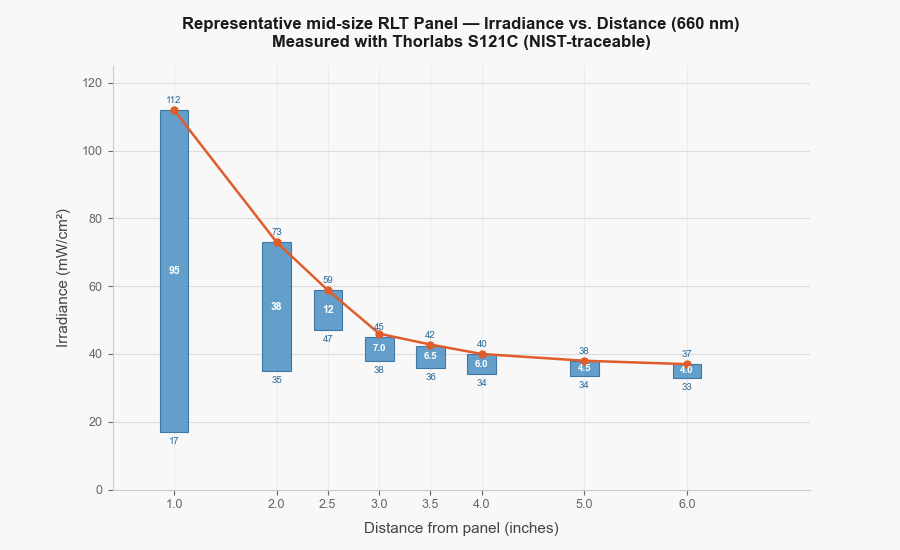
Figure 1. Measured irradiance versus distance for a representative mid-size LED photobiomodulation panel operating at 660 nm. Mean irradiance decreased from approximately 112 mW/cm² at 1 inch to 37 mW/cm² at 6 inches. Error bars indicate the range of measured irradiance values observed across the emitting surface. Measurements were performed using a ThorLabs PM100D optical power meter and S121C photodiode sensor.
The significance of this measurement is not that one panel performs better or worse than another. Rather, it illustrates a general characteristic of diverging LED sources: treatment geometry strongly influences irradiance. Because PBM dose is proportional to irradiance and time, two sessions of identical duration can deliver substantially different doses if distance and positioning are not controlled. But these are engineering problems, not fundamental limitations of the LED source itself.
A controlled LED delivery system, one that fixes geometry, monitors output throughout the session, and confirms the dose actually delivered, addresses the same variables the clinical setting manages through practitioner skill and source collimation. The wavelengths are the same. The dose targets drawn from the research literature are the same. What changes is how reliably those targets are met.
This matters because the PBM research literature specifies dose in J/cm² not “ten minutes under a laser” or “a professional application.” If the evidence base is built around delivered dose at a given wavelength, then a device that controls and confirms delivered dose is engaging with the research on its own terms. One that does not is hoping the geometry worked out.
Where the Question Actually Leads
The LED versus laser debate, framed as a question of biological mechanism, may be asking the wrong thing. The evidence suggests that coherence is unlikely to be the primary driver of efficacy, while the practical importance of penetration depth remains dependent on wavelength, tissue properties, and delivery conditions. The more consequential difference between the two source types is geometric, and that difference is most relevant in contexts where delivery is otherwise uncontrolled.
In a clinical setting, the laser’s collimation provides irradiance stability that an LED source requires more careful engineering to replicate. That engineering requirement is real. It is also solvable.
There are contexts where lasers may retain a genuine advantage. Highly targeted single-point applications, where beam precision matters more than area coverage, favor a collimated source by geometry. Deeper tissue penetration is frequently cited as another laser advantage, though the optical physics as shown by Kaub and Schmitz make this claim harder to sustain than it is often presented. These are areas where there are not yet settled conclusions.
For treatment applications beyond localized point targeting, source type may be less important than the delivery system surrounding it. Part of what a clinical laser system is purchasing is not simply a source of photons, but a delivery architecture designed to make dose more predictable. A well-engineered LED system that controls geometry, monitors output, and confirms delivered dose is addressing the same variables that make clinical laser delivery effective, through different means, at different cost, without the requirement of a professional to administer it.
The laser system costing tens of thousands and an effective LED-based home device may not be stimulating fundamentally different biological mechanisms. They may simply be using a different approach to controlled light delivery.
References and Further Reading