
Why session duration alone cannot determine delivered optical dose, and how measurement-informed stabilization changes what can be known.
Much of my engineering background has been in measurement systems where small errors accumulate unless they are explicitly modeled and corrected. In those environments, understanding uncertainty is not optional—it defines whether a system is usable. Calibration targets of 0.1% uncertainty are routine. That experience shaped how I approached optical dose delivery when developing photobiomodulation hardware.
Photobiomodulation devices present a structurally similar challenge. Most systems specify electrical input power or nominal irradiance, but the quantity that matters biologically is delivered optical dose. Dose is the time integral of irradiance over a session. Because even small deviations in output accumulate across that integral, accurately knowing delivered dose (dose accuracy) requires either stabilizing irradiance or explicitly modeling its variation.
Why dose matters more than power
There are three quantities commonly conflated in photobiomodulation device specifications, and they are not interchangeable.
Electrical drive power—watts consumed from the power source—tells you nothing directly about optical output. LED efficiency varies with junction temperature, drive current, and wavelength. A fixed electrical input does not produce a fixed optical output.
Irradiance—optical power per unit area at the target surface, measured in mW/cm²—is closer to what matters, but it is an instantaneous measurement. It describes the rate of energy delivery at a single point in time, not the total energy delivered over a session.
Dose is the integral that counts:
H = ∫ E(t) dt
H = dose (J/cm²) · E(t) = irradiance at time t (mW/cm²) · t = time (s)
Dose is the quantity most closely tied to biological response. It represents the total optical energy delivered per unit area over the course of a treatment. Because it is an integral, stability during the session matters just as much as the initial output level. A device that starts at 40 mW/cm² and drifts to 28 mW/cm² by the end of a ten-minute session does not deliver the same dose as one that holds 34 mW/cm² throughout—even if both begin at similar levels.
The session timer is not a dose meter. It is a dose meter only if irradiance is assumed constant and that assumption is validated.
Why irradiance changes during a session
Output drift during a session is expected physics, not a defect. Several mechanisms contribute, and they interact.
LED quantum efficiency is temperature-dependent. As junction temperature rises from ambient toward thermal equilibrium, optical output falls for a fixed drive current. The magnitude depends on the specific diode and wavelength—red emitters and NIR emitters have different temperature coefficients, so a dual-wavelength device will see the two channels drift at different rates.
Thermal boundary conditions determine how quickly the junction reaches equilibrium and what that equilibrium temperature is. A compact handheld device with a small heatsink mass reaches equilibrium faster than a large panel with significant thermal capacitance, but both will reach it eventually. Contact against skin introduces an additional boundary: heat transfer from the emitter into tissue adds a cooling path absent during bench characterization, which changes the equilibrium point session-to-session.
Drive conditions also matter. At high duty cycles, a switching LED driver can behave differently than at moderate loads. Inductor saturation, efficiency variation, and ripple characteristics all contribute to the effective current delivered to the LED, and therefore to optical output.
The practical consequence: a device that begins a session at its nominal irradiance will not maintain that output. Without active correction, the dose delivered over a 10-minute session is lower than a simple multiplication of nominal irradiance by session time would suggest—and the shortfall is invisible to a user controlling only duration.
The gap between expected and actual dose is not cosmetic. It represents the difference between what a user calculates based on session time and nominal specification, and what is actually delivered. That gap is invisible unless the device is measuring irradiance continuously.
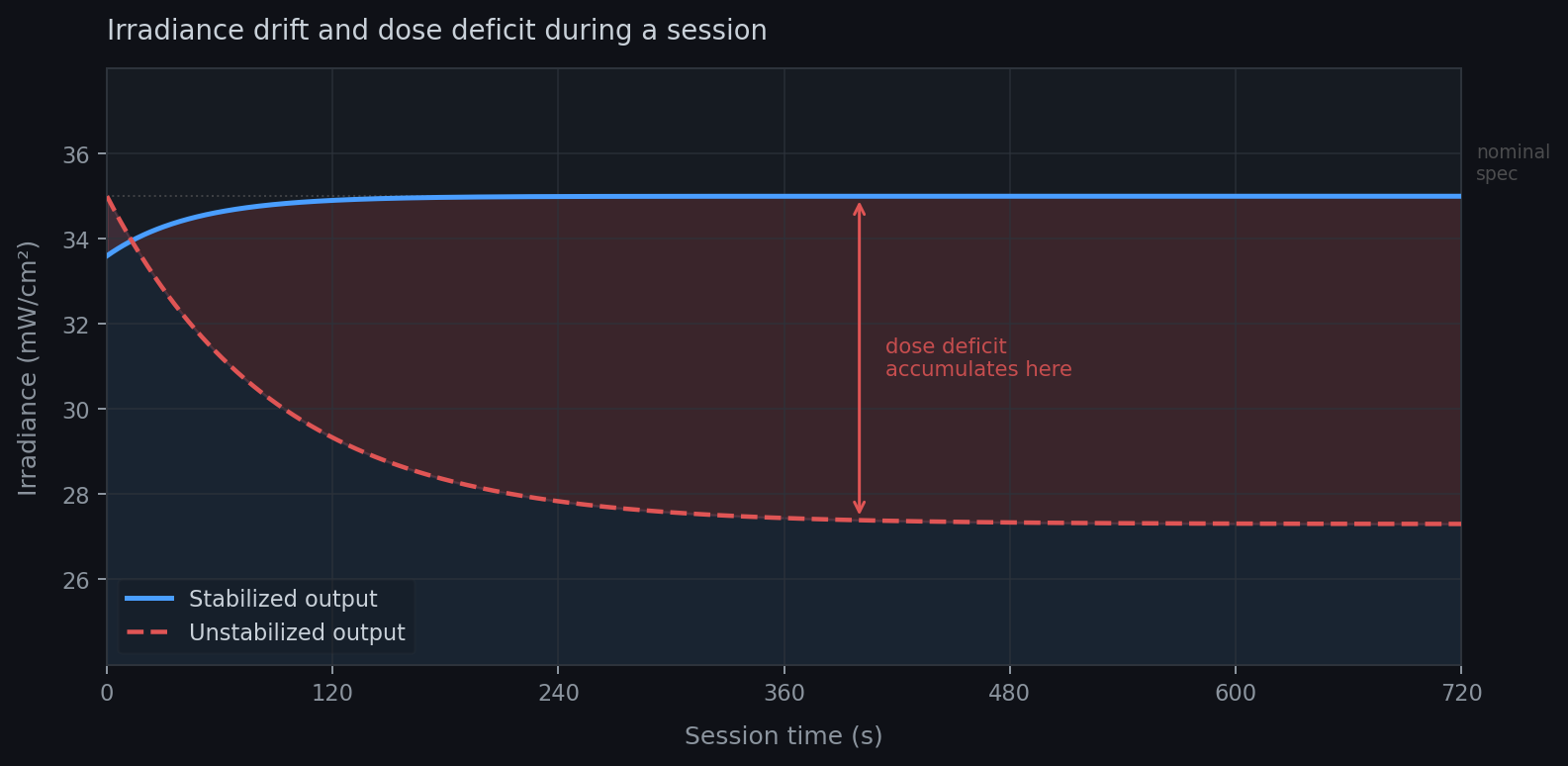
Irradiance drift over a session for a stabilized versus unstabilized device. The shaded area between the two curves represents the dose deficit — optical energy the user does not receive relative to a device holding stable output. Because dose is the time integral of irradiance, this gap accumulates across the full session duration and is invisible to a user controlling only session time.
Why this affects both handheld devices and panels
These effects are present in all LED-based photobiomodulation devices, regardless of form factor. In large-area panels, the problem may be less visible because sessions are often longer, thermal equilibrium assumptions are implicit rather than measured, and irradiance variations average across a larger emitting area. But the physics is the same. Thermal gradients across a panel’s emitting surface and efficiency tradeoffs between emitter zones are not always modeled explicitly, and without stabilization or measurement-informed compensation, irradiance may change during a session in ways that are invisible to the user but directly affect delivered dose.
In some respects the problem can be more pronounced in panel systems precisely because the scale makes it harder to instrument. A single handheld device has a well-defined optical aperture and a small number of emitters that can be characterized thoroughly. A large panel with hundreds of emitters and significant geometric variation is harder to characterize per-unit without dedicated measurement infrastructure.
Why time-only control cannot determine dose accurately
The dominant control paradigm in consumer photobiomodulation devices is duration-based: set a session time, apply the device, stop when the timer expires. This approach implicitly assumes that irradiance is constant and equal to the device’s nominal specification throughout the session. Both of those assumptions are fragile.
Nominal irradiance specifications are typically measured once, under controlled conditions, often at a specific drive current and thermal state. That measurement may not represent steady-state output under typical use conditions. It almost certainly does not represent output mid-session as the device approaches thermal equilibrium.
More fundamentally, because dose is the integral of irradiance over time, any assumption about irradiance constancy directly limits how accurately delivered dose can be known. A device that allows irradiance to drift by 20% over a session and controls only session duration has, by construction, a 20% uncertainty floor in delivered dose—before any other measurement errors are considered.
Implication: Duration-controlled devices without irradiance feedback cannot report dose with meaningful precision. They can report session time. These are not the same quantity.
Why this problem is rarely addressed in consumer PBM devices
Stabilizing irradiance across a session requires measurement infrastructure, empirical characterization across operating conditions, and embedded control informed by that characterization. Most consumer photobiomodulation devices are not designed around this workflow, so session duration becomes a proxy for dose rather than a measurement of it.
Measurement-informed stabilization strategy
To address this problem, we built an empirical dataset relating irradiance to temperature, time, and drive conditions across a wide operating envelope. This involved sustained measurement under varied thermal loads, contact configurations, and duty cycle settings—collecting enough data to observe how output evolves from cold start through thermal equilibrium and into extended operation.
Several candidate model structures were evaluated. Predictors without strong correlation to measured output were identified and discarded rather than retained as weak contributors. The goal was to identify the subset of variables that genuinely determine output behavior, not to fit a model with maximum parameters.
Critically, the objective was not simply to estimate output at a single operating point. The model needs to hold across the full duration of a session—from the transient warm-up phase through steady state—because dose is accumulated over that entire interval. A model accurate only at equilibrium misses the transient where the most output variation occurs.
Why interpretable models matter in embedded control systems
Compact, interpretable models were preferred over large black-box predictors. This preference is not arbitrary. An embedded system that corrects output based on a model it cannot explain is a system whose failure modes cannot be characterized. When model behavior needs to be verified—against bench measurements, across unit-to-unit variation, after a firmware update—interpretability is what makes verification tractable.
A model that can be read, understood, and tested against physical intuition is a model that can be trusted. A model that produces correct outputs under nominal conditions but fails silently under edge cases cannot be validated without exhaustive empirical coverage. In a system where the output determines delivered dose, silent model failures are not acceptable.
What stabilization enables
When irradiance is held consistent across the session, dose becomes a measurable quantity rather than an estimate derived from nominal specifications. The session timer becomes a dose timer. The distinction matters because it changes what the device can claim to know about its own output.
The companion app’s Dynamic Optical Response screen makes this relationship visible. The reflected optical return trace over session time provides a real-time record of contact quality and output stability. A stable trace confirms that the irradiance integral is proceeding as expected; a degraded trace identifies sessions where delivered dose departed from the target. That record is logged per session, not just displayed transiently.
[App screenshots: session summary card and Dynamic Optical Response trace — Session 212, Quality 100%, stable optical return throughout 612-second session]
Without stabilizing irradiance—or explicitly modeling its variation—accurately knowing delivered optical dose is not possible. The session record shown above is meaningful only because the underlying output is controlled. A session log from a device with uncontrolled irradiance drift is a record of elapsed time, not dose.
Remaining uncertainty sources
Irradiance stabilization eliminates one category of dose uncertainty—session-duration variation due to thermal drift. It does not eliminate all uncertainty sources. The remaining contributors are worth characterizing explicitly.
| Source | Nature | Mitigation approach |
|---|---|---|
| LED aging | Slow, monotonic output decline over operating hours. Magnitude depends on drive current and thermal history. | Periodic recalibration against a reference standard, or conservative uncertainty margin on lifetime specifications. Open variable in most LED-based systems without scheduled recalibration. |
| Geometry variation | Distance and angle between emitter and target tissue affect delivered irradiance. Contact devices constrain this; non-contact devices do not. | Defined contact geometry with mechanical registration. Contact quality sensing to detect deviations from the nominal aperture-to-tissue interface. |
| Contact variation | Skin optical properties vary between individuals, anatomical locations, and sessions. Reflectance and absorption at the tissue interface affect the delivered dose fraction. | Reflected optical measurement during session. The contact quality metric in the app quantifies this variation session-to-session. |
| Sensor uncertainty | The irradiance measurement chain—photodiode, transimpedance amplifier, ADC, calibration transfer—has its own uncertainty budget. | NIST-traceable per-unit calibration using a calibrated reference instrument. Uncertainty propagated through the calibration chain and documented on a per-unit certificate. |
Long-term LED aging is probably the most significant open variable in consumer LED-based systems. Without periodic recalibration against a reference standard, a device that was accurate at time of manufacture will drift toward underdelivery over its operating lifetime. The rate depends on the specific emitters and operating conditions, but it is present in all LED systems and is not typically addressed in consumer photobiomodulation products.
Contact variation is the other practically significant source for a contact device. Skin is not a uniform optical target. A session on one anatomical location may have substantially different optical coupling than the same session on another location. The contact quality sensing built into the Rejuv quantifies this variation in real time, which at minimum makes it visible rather than invisible. Quantifying its effect on absolute dose delivery is ongoing work.
The calibration chain uncertainty is bounded by the reference instrument used for per-unit calibration—in our case, NIST-traceable through the measurement instrument manufacturer’s calibration certification. That uncertainty is small relative to the other sources listed here, but it is present and is documented per unit.
Summary
Electrical power and irradiance are not dose. Dose is the integral of irradiance over time, and the accuracy of that integral depends directly on output stability during the session. A session timer is a dose timer only if irradiance is held constant and that constant is known accurately. Both conditions require hardware-level stabilization and calibrated measurement, not nominal specifications derived from datasheet values.
The stabilization approach used in the Rejuv was built from empirical characterization across a wide operating envelope, with model structures chosen for interpretability and verifiability rather than fitting performance under nominal conditions alone. The remaining uncertainty sources—aging, geometry, contact variation, calibration chain—are characterized and where possible mitigated by design. The Dynamic Optical Response trace gives the user a session-level record of how well the irradiance integral held, not just how long the session ran.
Delivering a known dose reliably is a harder problem than it appears from the outside. Making the difficulty visible is part of how we approach it.