
Red light therapy has a dosing problem, and it’s not the one most people think about.
The research is real. More than 11,000 peer-reviewed studies on PubMed document the effects of red and near-infrared light on tissue repair, recovery, and cellular function. Those studies specify doses in joules per square centimeter, a precise, measurable quantity. They used calibrated instruments to deliver them.
The device sitting in your living room gives you a timer.
That gap — between what the research measured and what consumer panels actually deliver — is what motivated us to take a closer look. We used a LumeBox, one of the better-regarded mid-sized panels on the market, and used a NIST-traceable optical power sensor to measure its irradiance at different positions.
What we found is worth understanding if you use one of these devices, or are thinking about it.
What the Manual Says
The LumeBox is a well-regarded mid-format red light therapy panel — the kind that shows up on serious RLT buyer lists alongside Joovv, Mito Red Light, and others built around similar LED array designs. It’s a reasonable representative of the category.
The guidance in the manual is straightforward. Don’t place it directly on the skin. Stay within six inches of the panel. First time users are recommended to start with 1 to 2 minutes and working your way up to 12 minutes. It beeps after six minutes and runs to twelve minutes. Use red light, near-infrared, or both.
That’s the complete picture the manual gives you. A boundary for distance and a time range.
No mention of how much light you’re actually receiving at different points within that six-inch window. No dose in joules per square centimeter for different timing intervals. No guidance on whether two inches delivers the same result as five inches, or whether it matters where on the panel surface you’re positioned.
Just: closer than six inches, six to twelve minutes. For a user trying to replicate what a clinical study actually delivered, it leaves the most important variable, dose, entirely uncontrolled.
What We Measured
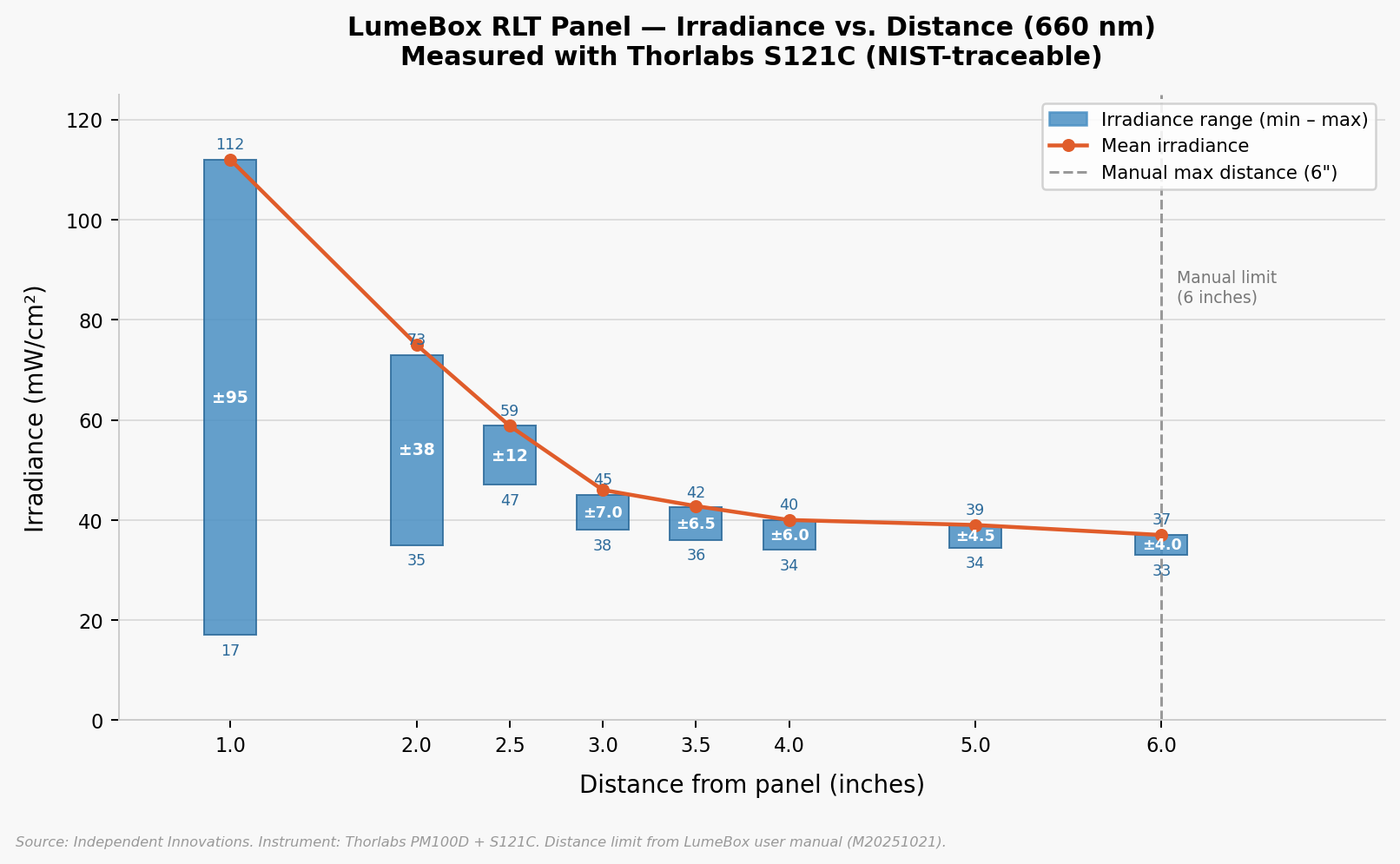
To characterize what a user actually receives at different operating distances, we mounted a Thorlabs S121C silicon photodiode sensor — the same NIST-traceable instrument class used in photobiomodulation research — on a fixed stand and took irradiance readings across the panel face at distances from one to six inches. At each distance we recorded both the minimum and maximum readings across the illuminated area, capturing the spatial variation a user would encounter depending on exactly where they positioned the device.
The results are shown in the chart below.
Two things stand out immediately.
The first is spatial non-uniformity at close range. At one inch from the panel, the difference between the lowest and highest irradiance reading across the panel face is 95 mW/cm² — nearly as large as the maximum reading itself. A user holding the panel at that distance could be receiving anywhere from 17 to 112 mW/cm² depending on exactly where the sensor sits relative to the LED array. That’s not a small variation. It’s probably fine if the user continuously moves during the treatment as this would tend to average out, but what it will average out to would require a much more elaborate experimental setup.
By three to four inches, spatial variation collapses to a narrow band — roughly ±7 mW/cm² or less. The panel output stabilizes. From that point out to the six-inch manual limit, irradiance stays in the 33–45 mW/cm² range with modest variation.
So the panel has a sweet spot. The problem is that nothing tells the user they’re in it — or how long to stay there once they are.
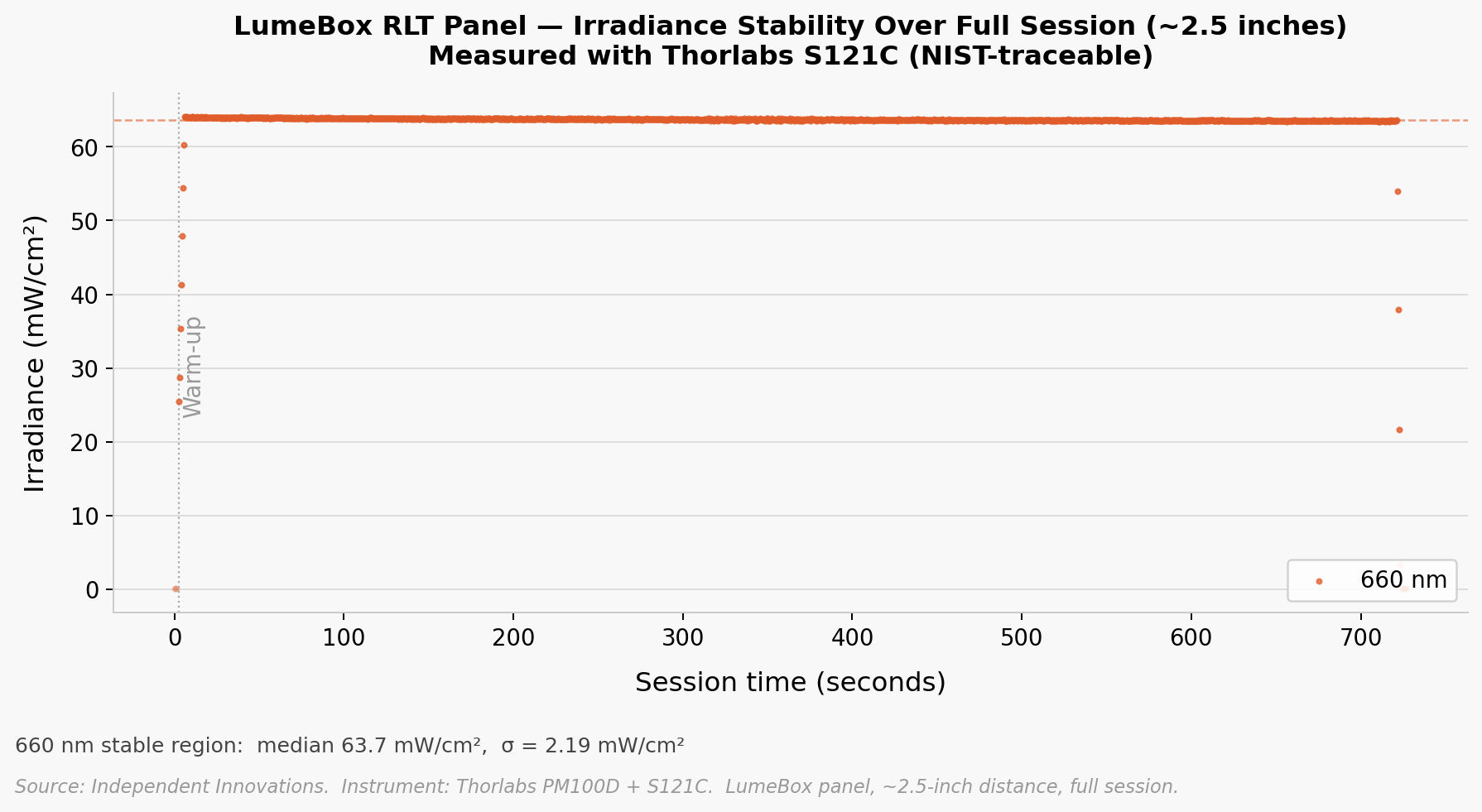
We also measured output stability over a complete session at approximately 2.5 inches. The result demonstrated it uses a very well-designed LED driver: irradiance held steady for the duration of the session with minimal drift. This is not easy to achieve in a battery powered system. The irradiance your tissue receives is still uncontrolled — but that’s a positioning problem, not a panel quality problem.
From Irradiance to Dose — Why the Numbers Matter
The research on red light therapy doesn’t talk about minutes. It talks about dose — measured in joules per square centimeter (J/cm²). That’s the quantity researchers controlled when they studied wound healing, tissue repair, and recovery. It’s the number that determines whether a session is in the range the literature actually examined.
The relationship between irradiance and dose is straightforward:
Dose (J/cm²) = Irradiance (mW/cm²) × Time (seconds) ÷ 1000
The LumeBox manual signals the six-minute mark with a beep. We’ll use it as the reference point.
At six minutes, depending on where within the panel’s operating range you happen to be positioned, your dose looks like this:
| Distance / Position | Irradiance (mW/cm²) | Dose at 6 min (J/cm²) |
| 1 inch — low spot | 17 | 6.1 |
| 3–4 inches — stable zone | 40 | 14.4 |
| 2.5 inches — upper range | 58 | 20.9 |
| 1 inch — hot spot | 112 | 40.3 |
The range at the six-minute beep spans from 6.1 to 40.3 J/cm², a more than sixfold difference, without the user changing anything other than where they’re holding the device.
To put that in context: clinical studies on wound healing and soft tissue repair commonly work in the 4–20 J/cm² range. A treatment area positioned at a hot spot at one inch hits 40 J/cm² at the beep — double the top of that range. A treatment area at the low end of the same distance hits 6.1 J/cm² — therapeutic by some measures, but not the dose they may have intended.
None of this is a flaw in the panel design. LED arrays behave exactly as physics predicts. The issue is that time alone — without knowing irradiance — cannot tell you what dose you received.
This Is a Geometry Problem
It’s worth being direct about what this data does and doesn’t show.
We measured a LumeBox because it’s a well-regarded panel with published specifications and clear manual guidance, a fair representative of the mid-format LED panel category. The stability over time and battery life was very impressive. The findings are not an indictment of LumeBox at all. The spatial non-uniformity at close range, the irradiance falloff with distance, the stabilization beyond three to four inches — these are the expected behaviors of an LED array. Physics doesn’t make exceptions for brand names.
Panels in this format — LumeBox, Joovv, Mito Red Light, and others built around similar LED matrix designs — will exhibit the same pattern. The same geometric falloff principles apply equally to all of them. The specific numbers will vary by panel design, LED density, and optical configuration. The underlying behavior will not.
What varies between brands is not whether this problem exists — it’s whether they give users the tools to know where they stand within it. Currently, it does not seem any of them do. The guidance across the category is consistent: a distance recommendation and a time range. Dose in joules per square centimeter, the quantity the research actually measured, doesn’t appear.
What a Solution Actually Looks Like
The measurement problem is solvable. If you own a panel and want to know what you’re actually receiving at your treatment distance, your specific panel, your specific position, you need more than a broadband power meter. Accurate characterization of irradiance, spectrum, and distance together would require instrumentation designed specifically for photobiomodulation measurement — the motivation behind projects like OptiVerity.
But measurement alone only gets you so far.
Even with accurate irradiance data in hand, the panel usage model has a practical problem that numbers can’t fix. To stay within the stable zone our data identified, roughly three to six inches in this category, you have to hold that position consistently for the duration of the session. Six to twelve minutes. With a panel that isn’t light. Without drifting closer or further as you relax, shift, or simply stop thinking about it.
That’s not how people actually use these devices. Maintaining a fixed distance for six to twelve minutes is difficult in realistic usage conditions, particularly with handheld or unsupported devices. It is an ergonomic problem. The panel format assumes a level of positional precision that isn’t realistic for a relaxed session. Most people want to sit comfortably, read, watch something, or simply rest while the session runs.
This is what motivated a different approach entirely: a contact-based device where distance is no longer a variable, dose is measured directly at the treatment site, and the session confirms what was actually delivered. The research specifies a dose in joules per square centimeter. That number shouldn’t depend on how still you managed to sit.